
Web accessibility in Nepal shifted from a best practice to a regulatory requirement. For banks, fintech platforms, and organizations under NRB oversight, understanding what’s now expected — and what practical steps are available — is worth some time.
What Did NRB Actually Require?
NRB’s amended unified directives cover several areas of disability-friendly service. On the digital side, the key requirements are:
- Financial institutions must design their websites and mobile applications to accommodate visually impaired users
- At least one accessible ATM with Braille signage, control buttons, and audio support at all major ATM lounges
- At least one disability-friendly branch in every local government unit (through inter-institution collaboration)
- Digital banking access granted based on the customer’s own self-declaration — not a bank’s internal assessment
The self-declaration requirement is a meaningful shift. It removes a process that many customers found opaque or difficult to navigate, and places reasonable digital access closer to the customer’s control.
The Broader Legal Context
| Framework | What It Covers |
| Disability Rights Act | Establishes inclusive access to services and public facilities, including digital environments |
| Nepal Constitution | Equal access to information as a fundamental right, increasingly applied to digital services |
| Digital Nepal Framework 2.0 | Inclusive digital infrastructure as a core goal of the government’s transformation roadmap |
| NRB Unified Directives | Banks and financial institutions must make websites and apps usable for visually impaired users |
A peer-reviewed evaluation of 25 federal government websites found that only 4% met WCAG Level A conformance, and just 24% were free of ARIA errors. The regulatory infrastructure exists; consistent implementation is the open challenge.
What This Means for Private Sector Organizations
For banks, insurance companies, fintech platforms, and other NRB-regulated entities, the directives create a clear expectation: websites and apps need to be usable by visually impaired customers. In technical terms, this maps closely to WCAG 2.1 AA — the internationally recognized benchmark for digital accessibility.
Full WCAG conformance requires significant development effort: accessible markup, semantic heading structure, keyboard navigation, properly implemented ARIA attributes, and regular audits. For organizations that need to demonstrate progress quickly while longer-term remediation is planned, AllyKit offers a low-friction starting point.
A Fast Implementation Option: AllyKit
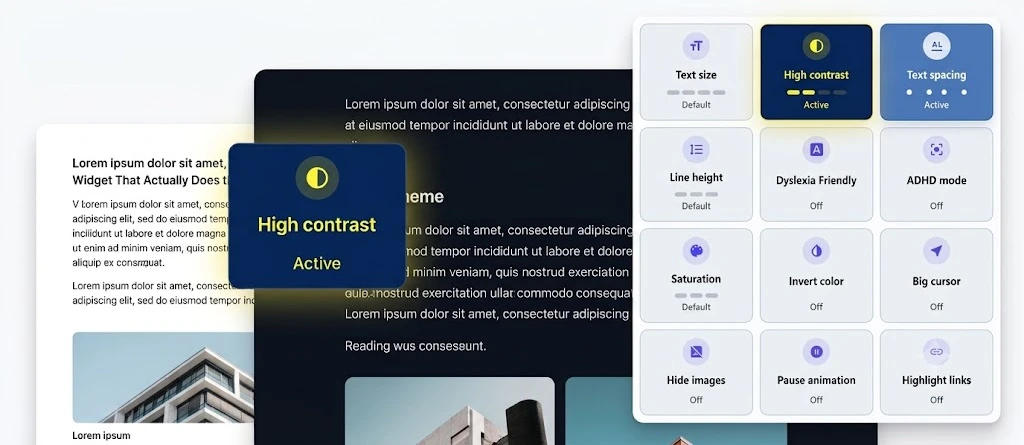
AllyKit is a zero-dependency JavaScript widget that adds a user-controlled accessibility panel to any website via one script tag. It covers text scaling, four contrast modes (including a WCAG AA-compliant dark mode), dyslexia-friendly fonts, animation pausing, a built-in screen reader, and more. User preferences persist across sessions via localStorage. It’s free and open-source.
| <!– One-line installation –> <script src=”https://cdn.jsdelivr.net/npm/@preepo/allykit/ally-kit-min.js”></script> |
AllyKit won’t substitute for a full WCAG audit or structural HTML changes — screen reader users on NVDA or JAWS still need properly labeled forms, logical page structure, and keyboard-accessible interactions. But it gives users immediate options, which matters for compliance timelines and for actual customers trying to use the site today.
Frequently Asked Questions
Is there a deadline for NRB compliance?
NRB directives typically include timelines in the circular itself. Organizations should consult the specific amended directive text and seek legal or compliance review for their situation.
Does adding an accessibility widget satisfy NRB’s requirements?
A widget alone is unlikely to constitute full compliance. It’s a useful tool during a broader remediation process, but should not be treated as a complete solution.
What standard should Nepal financial institutions target?
WCAG 2.1 AA is the international benchmark most regulatory frameworks reference. Some organizations are beginning to plan for WCAG 2.2.
Are there free tools for testing accessibility?
Yes. WAVE (WebAIM), Axe (Deque), and the NVDA screen reader are free and widely used. The W3C Web Accessibility Initiative also publishes free evaluation methodology and guidance.
| TL;DR Nepal Rastra Bank (NRB) has amended its unified directives to require financial institutions to design websites and mobile apps for visually impaired users, deploy accessible ATMs with Braille controls and audio support, and grant digital banking access via customer self-declaration. Organizations now face clear regulatory expectations around digital accessibility — and tools like AllyKit offer a fast implementation path. |