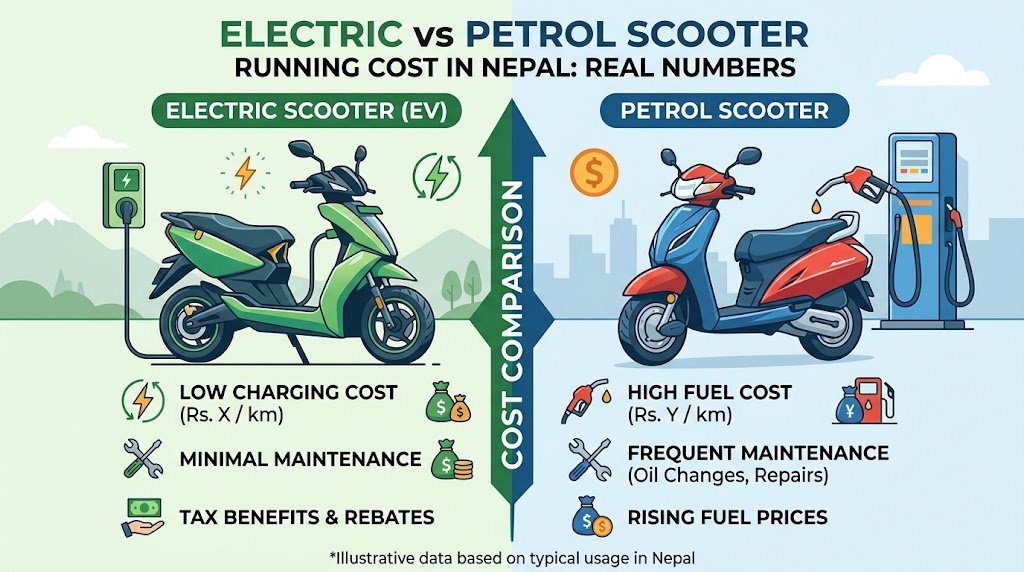
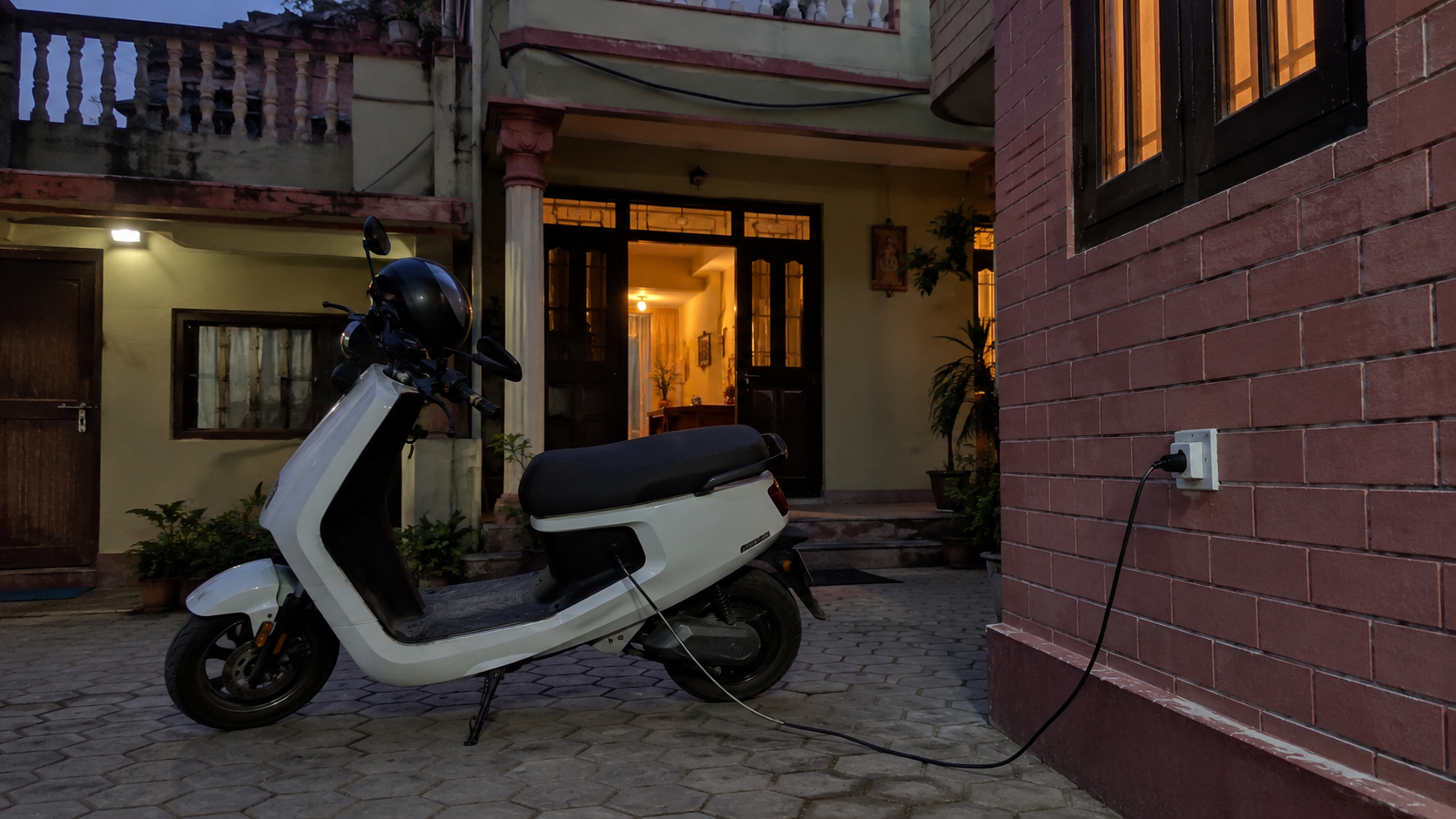

A full home charge for a typical electric scooter in Nepal costs somewhere around Rs 20 to Rs 50, depending on the size of the battery and which NEA tariff slab your household’s total monthly usage falls into. Larger, premium batteries can push a little past that range, but even then, it stays far below what filling a petrol tank cost.
The maths behind that number
Charging cost works out to battery capacity in kWh, which is the same thing as “units” on your NEA bill, multiplied by your per-unit electricity rate.
1. Find your scooter’s battery capacity in kWh from the spec sheet or manual, commonly 1.2 to 3.5 kWh for scooters sold in Nepal.
2. Find the NEA energy charge rate that applies to your household’s monthly usage bracket. For FY 2083/84, residential rates run Rs 3/unit for the first 20 units, Rs 6.50/unit for 21-30, Rs 8/unit for 31-50, Rs 9.50/unit for 51-250, and Rs 11/unit above 250.
3. Multiply battery capacity by the applicable rate to get the cost of one full charge.
Worked examples
| Battery size | Rate applied | Cost of one full charge |
| 2 kWh (typical budget scooter) | Rs 9.50/unit (mid-slab) | Rs 19 |
| 3.5 kWh (larger premium battery, close to the TVS Orbiter’s 3.1 kWh) | Rs 9.50/unit (mid-slab) | Rs 33 |
| 2 kWh | Rs 11/unit (top slab, high household usage) | Rs 22 |
These examples use NEA’s published mid-to-top slab rates. If your scooter charging pushes your total household units into a higher bracket than you’d otherwise land in, the last few units of that charge, and everything else in the house for that month, get billed at the higher rate, not just the scooter’s share.
Does charging a scooter push your whole house into a pricier slab?
It can, and this is the detail most owners miss. NEA bills the whole month’s units on one progressive scale; it isn’t scooter units and household units billed separately. If your family normally sits around 200 units a month and daily scooter charging adds another 60, your total for the month crosses into the 251-plus bracket at Rs 11/unit, which raises the rate on units you were already using, not just the new ones from the scooter. It’s still cheap next to petrol, but worth knowing before you assume the scooter’s charging cost in isolation is the whole picture.
How long does a full charge actually take?
Most scooters sold in Nepal charge fully from a standard wall socket in 3 to 6 hours, depending on battery size and the charger’s rated output. A handful of premium models support faster charging that cuts this meaningfully, but for the majority of budget and mid-tier scooters, an overnight charge is simply the practical routine.
Frequently asked questions
Q: Can I charge an electric scooter from any household wall socket?
Yes, for the vast majority of models sold in Nepal, using the charger that comes with the scooter. It’s still worth having a competent electrician confirm your home wiring and the specific socket you’ll use regularly can handle the load, particularly in older buildings.
Q: Does charging cost change with the seasons?
NEA’s slab rates don’t change seasonally, but your total household consumption might, more fans and coolers in summer, more heaters in winter, which can shift which slab your usage lands in and change your effective per-unit rate.
Q: Is it cheaper to charge at a public charging station instead of at home?
Usually the opposite. Public charging, particularly fast charging, is typically priced at a premium per unit compared to home slab rates, so home charging overnight is generally the cheaper routine when it’s available to you.