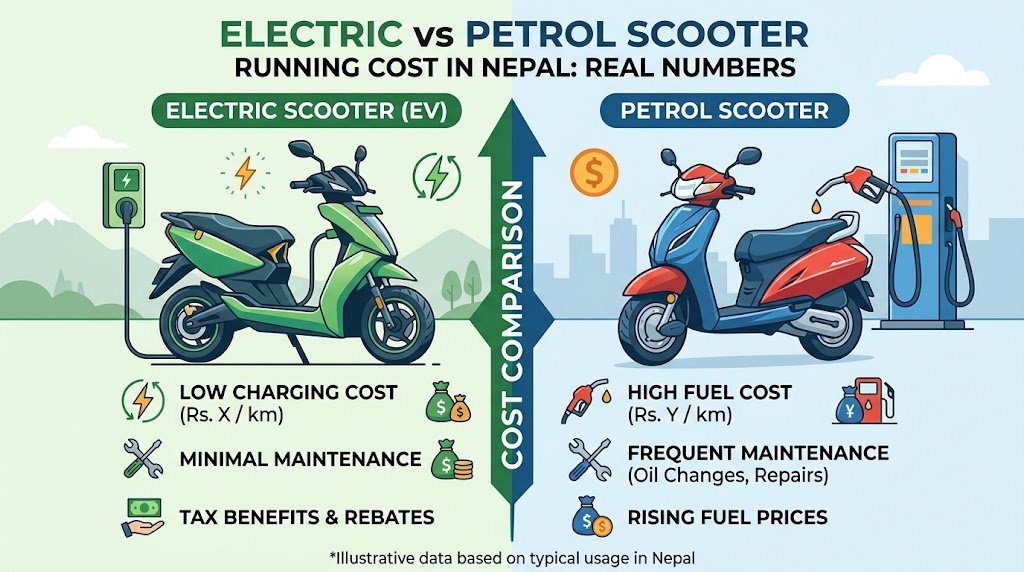

An electric scooter costs roughly Rs 0.49 per km to run; a petrol scooter costs roughly Rs 3.94 per km at current rates
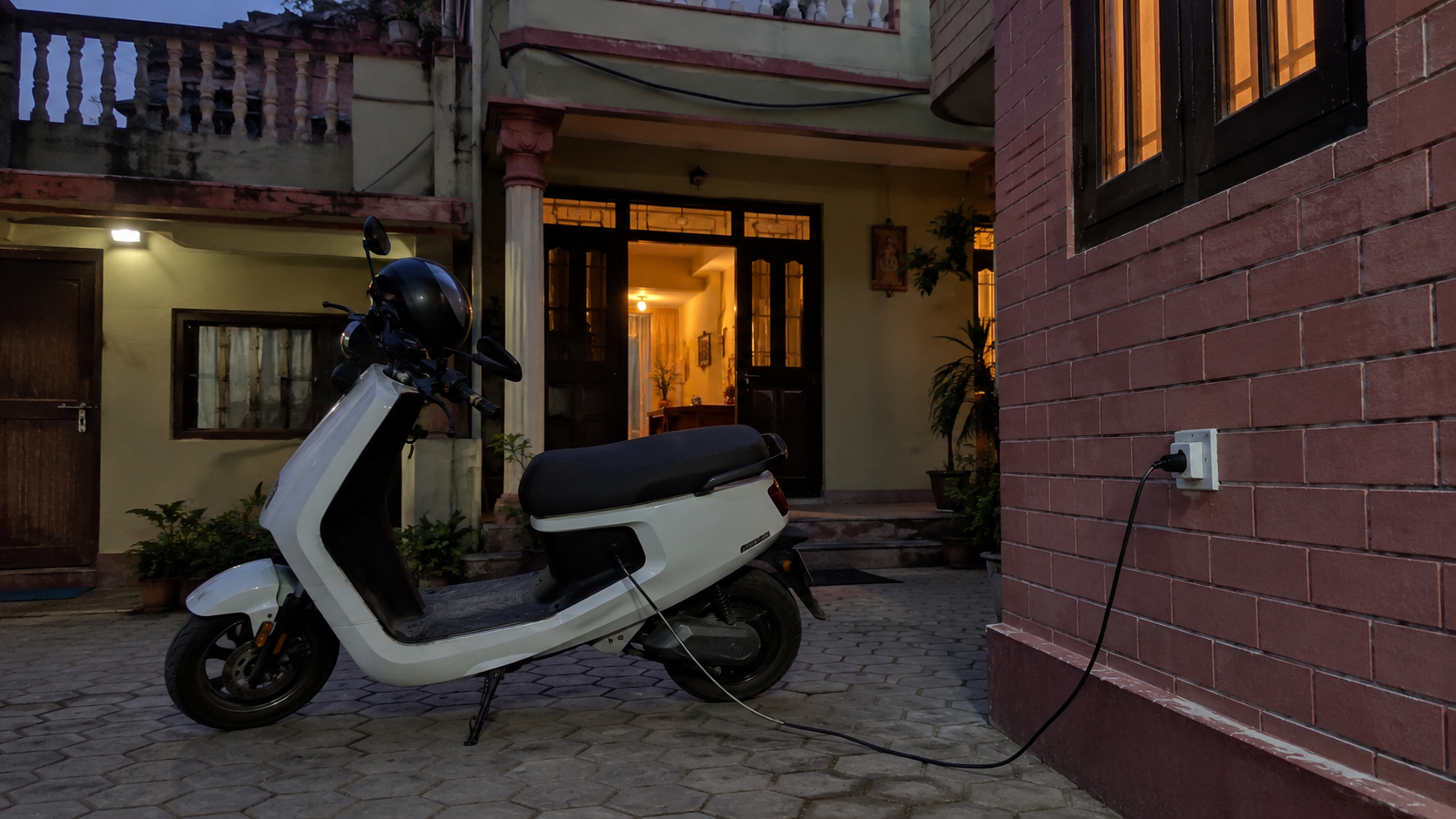
With petrol in Kathmandu at roughly Rs 197 per litre (per Nepal Oil Corporation) and a typical petrol scooter doing about 50 km per litre, that works out to Rs 3.94 per km. An electric scooter charging at home, on NEA’s common residential slab of about Rs 13 per unit, typically costs somewhere around Rs 0.49 per km for a 3 kWh battery pack delivering 80 km of real-world range. Over a 20 km/day commute, that gap adds up fast.
The maths, shown plainly
Petrol scooter cost per km:
Rs 197 per litre divided by 50 km per litre = Rs 3.94 per km
Electric scooter cost per km:
3 units of electricity at Rs 13 per unit = Rs 39 for a full charge
Rs 39 divided by 80 km range = Rs 0.49 per km
These are simplified figures. Your actual petrol mileage depends on riding style, traffic, hills, and how well the engine is maintained. Your actual electricity cost depends on which NEA slab your household falls into, since Nepal uses progressive tariff bands.
Monthly and yearly cost comparison
| Daily commute | Petrol monthly | Electric monthly | Monthly savings |
| 20 km/day | Rs 2,364 | Rs 294 | Rs 2,070 |
| 30 km/day | Rs 3,546 | Rs 441 | Rs 3,105 |
| 40 km/day | Rs 4,728 | Rs 588 | Rs 4,140 |
Figures assume 26 working days per month. Petrol cost uses Rs 197/litre at 50 km/litre. Electric cost uses Rs 13/unit for a 3 kWh battery delivering 80 km real range.
What this comparison leaves out
The upfront price gap is the first thing to account for. A decent electric scooter costs Rs 2,00,000 to Rs 3,00,000. A comparable petrol scooter costs Rs 1,80,000 to Rs 2,50,000. The electric model pays back that gap through lower running costs, but the payback period depends on how much you ride.
Battery replacement is the second factor. A lithium battery pack lasts roughly 3 to 5 years under normal use in Nepal. Replacement costs Rs 60,000 to Rs 1,50,000 depending on capacity. Spread that cost across the years of ownership and it narrows the running-cost gap, though it does not erase it.
Resale value is the third. Petrol scooters in Nepal hold value better because buyers trust the second-hand market. Electric scooters depreciate faster, partly because battery health is hard to verify and partly because the technology is still changing year to year.
FAQ
How much can I save per month switching to an electric scooter in Nepal?
At 20 km per day, the monthly fuel savings are roughly Rs 2,000 to Rs 2,500 after accounting for electricity costs. At 40 km per day, the savings climb to Rs 4,000 or more. Riders with very short commutes see smaller savings because the upfront price gap takes longer to recover.
Does electricity price change the answer if I ride more?
Yes. NEA charges progressive rates. If your household already uses a lot of units, adding scooter charging can push you into a higher slab where each unit costs more. The difference is usually small for a 3 kWh battery charged every few days, but it is worth checking your current bill before calculating exact savings.
Is petrol or electric cheaper over 5 years including maintenance?
Electric usually wins over 5 years if you ride 25 km or more daily, even after factoring in one battery replacement. For very low-mileage riders, the math is closer because the upfront price gap takes longer to recover.